
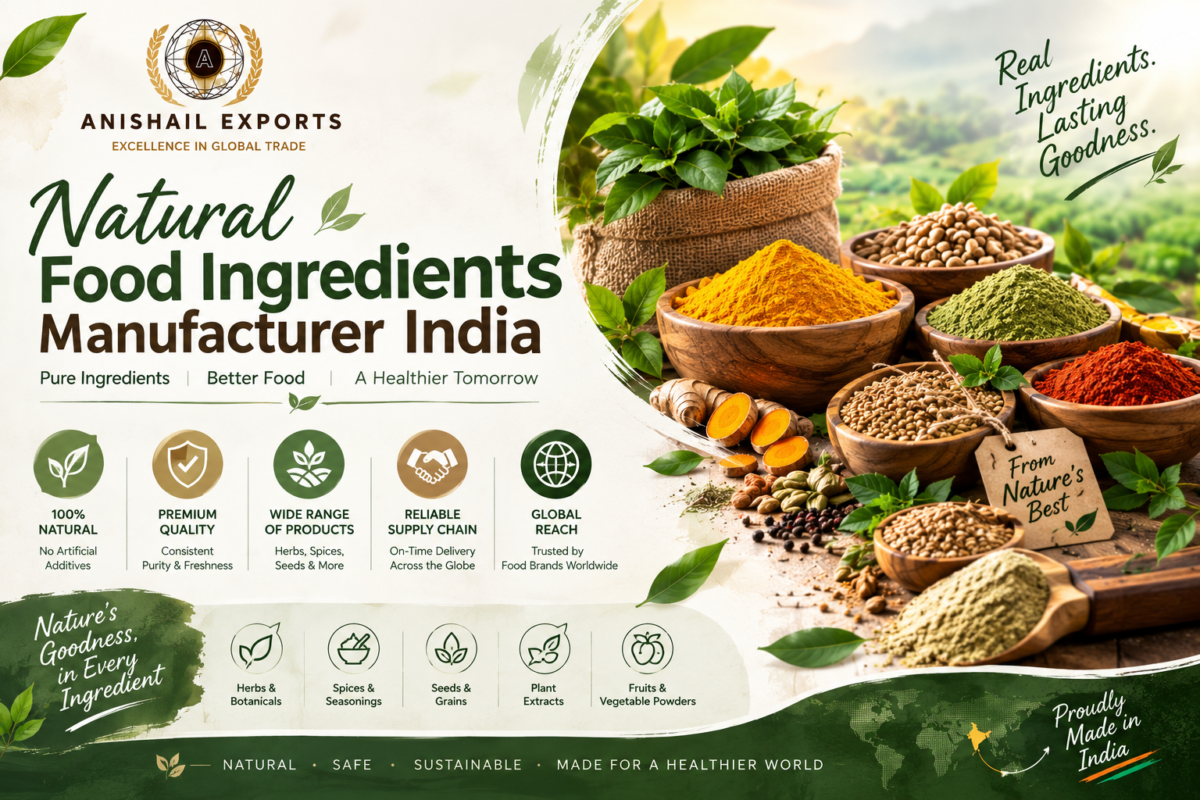
Ingredient lists get read closely now, not skimmed. Buyers want pure ingredients, and no artificial additives, synthetic dyes, or preservatives no longer pass unnoticed the way they used to. This has pushed food brands to look harder at who actually supplies their raw materials. India’s long farming history has made it one of the places brands turn to first.
A reliable natural food ingredients manufacturer in India can make or break a food brand’s reputation. A processor that delivers inconsistent batches or cuts corners on sourcing puts every product built on top of it at risk. Working with an established natural ingredients supplier in India is what keeps a recipe safe, consistent, and compliant with the regulations of whichever market it ships to.
What to Look for When Choosing Your Partner for Natural Food Ingredients Manufacturer
1. Real Quality Certificates
None of these certifications should be taken on the supplier’s word alone. A factory claiming to meet these standards without paperwork to back it up is a factory worth walking away from.
A processor worth trusting usually holds:
- FSSAI registration for domestic operations.
- ISO 22000 certification for a verified food safety management system.
- Good Manufacturing Practices certification for a clean processing floor.
- Organic or Kosher certification, where the target market requires it.
2. Knowing Your Crop Origins
Soil quality decides an ingredient’s purity before any processing even begins. Suppliers who buy straight from farmers, instead of going through middlemen, usually know which field a batch came from and how it was grown.
Food raw material suppliers worth working with can usually show:
- A clear trail from a specific farm plot to the delivery dock.
- Fair pay and stable working conditions for farm labour.
- Regular monitoring of harvest cycles to avoid sudden shortages.
- Testing of raw crops for heavy metal contamination before processing begins.

3. Gentle Processing Technology
Heat and chemical solvents destroy exactly what a buyer is paying for. A processor still relying on older, more aggressive extraction methods is often cutting costs at the expense of the final product’s quality.
Better facilities tend to use:
- CO₂ extraction uses pressure. No chemical solvents are needed. This leaves no solvent residue behind.
- Freeze drying uses little to no heat. Vitamins are less likely to break down.
- Vacuum evaporation uses low temperatures. This helps retain the natural taste.
- Microencapsulation protects active oils. It helps prevent them from going stale during storage.
4. In-House Testing Labs
Waiting on an external lab to test every incoming shipment slows everything down. A delay of even a week at the testing stage can stall an entire production run.
A facility running its own lab can typically handle:
- HPLC testing to measure the strength of active plant compounds.
- Heavy metal screening for lead, arsenic, and mercury.
- Microbiology checks for mould, yeast, and E coli.
- Moisture and solubility testing to confirm smooth blending.
5. Help with Custom Recipes
Most new food concepts do not work with an ingredient straight off the shelf. They need flavour adjusted, texture corrected, or solubility issues solved before a formula is ready to scale.
A manufacturer with real formulation support usually offers:
- Custom colour and flavour matching using fully botanical sources.
- Testing inside real food applications, such as bakery or dairy lines.
- Shelf life testing under high heat storage conditions.
- Fine-tuning of active ingredient levels to support specific health claims.
6. Ability to Scale with Demand
A supplier that handles a small pilot batch well is not automatically ready for what comes after a product takes off. Order volumes can jump from a few kilograms to several tonnes within a season if a product does well.
Before signing a contract, it helps to check for:
- Flexible minimum order sizes for early pilot batches.
- A clear path to scale from small trial quantities up to several tonnes.
- Multiple processing lines to avoid shutdown-related delays.
- Climate-controlled storage to keep raw material from spoiling.
7. Environmentally Responsible Operations
Buyers increasingly notice what a brand’s supply chain looks like behind the label. Repurposing leftover material tends to show up at processors who take the rest of this seriously too.
Genuinely sustainable operations usually include:
- Wash water gets recycled instead of discharged as waste.
- Facilities often run partly or fully on solar power or biomass boilers.
- Packaging gets reduced to cut down on single-use plastic.
- Leftover plant fibre gets turned into organic fertiliser rather than thrown out.
8. Transparent Pricing Terms
Monsoon patterns and crop yields move prices constantly. Food raw material suppliers in India need to account for these changes when planning long-term sourcing. A supplier without fixed-term agreements passes all of that volatility straight onto the brand buying from them.
Fair commercial terms typically include:
- Fixed pricing agreements to protect against sudden market swings.
- An itemised cost sheet separating raw material, processing, and freight charges.
- Volume-based discounts for long-term order commitments.
- Reasonable credit and payment terms.
9. Safe Global Logistics
An ingredient can pass every quality check and still arrive damaged if the packaging fails during shipping. Certificates and shipping records say more about a supplier’s export capability than anything printed on their website.
A capable exporter should be able to show:
- Airtight, light-blocking packaging that keeps out humidity.
- Refrigerated freight options for sensitive oils and liquid enzymes.
- Complete documentation, including certificates of analysis and origin papers.
- A consistent record of on-time dispatches through major ports.
10. Consistency Across Every Batch
One strong batch does not prove much on its own. What actually matters is whether batch fifty performs the same as batch one, regardless of the season or the source crop used for natural food raw materials.
A processor serious about consistency usually maintains:
- Detailed batch records available on request.
- Standard operating procedures that stay fixed even as staff change.
- Retained samples from past batches for comparison.
- Clear documentation tracing any variation back to its source.
Brands looking for high purity, traceable ingredients for an upcoming product line can request sample batches and certified specifications directly from Anishail Exports.
Why Choose Anishail Exports?
Anishail Exports handles everything from food additives and industrial chemicals to herbal
extracts and specialised raw materials across multiple sectors. They keep a tight grip on quality
control, manage bulk orders smoothly, and provide genuine manufacturing support, making
them a dependable partner for businesses that require a supplier they can actually count on.
Conclusion
Choosing a supplier on price alone, without checking lab standards or how crops are actually sourced, tends to surface as a quality problem later, often after a product is already on shelves and harder to fix. Checking a processor’s lab work and farm relationships before signing anything is especially important when dealing with a natural food ingredients manufacturer in India.
Buyers are asking more questions about where ingredients come from, and that trend is not slowing down. A processor with proper sourcing and testing records can actually answer those questions instead of dodging them. Anishail Exports works with brands on this kind of sourcing and formulation work for anyone looking to strengthen their supply chain.